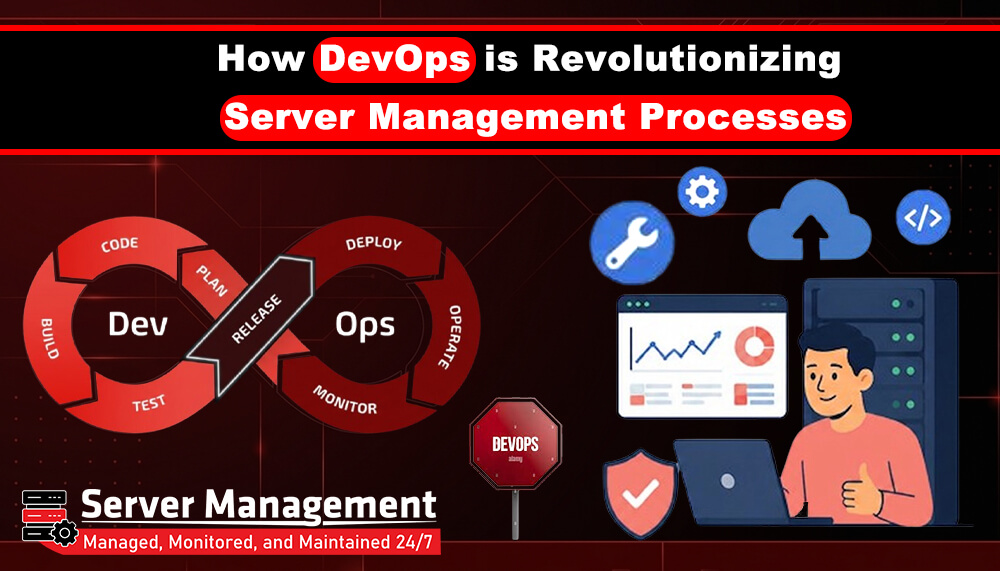
How DevOps is Revolutionizing Server Management Processes
Traditional server management involved many manual tasks such as configuring servers, installing dependencies, updating services, and fixing issues one by one. These methods were slow and error-prone. DevOps changes this by using automation, standard processes, and continuous improvement.
Here are the major benefits:
1. Automation & Infrastructure as Code (IaC)
With DevOps, servers and configurations can be defined using code.
Tools like Terraform, Ansible, and CloudFormation allow teams to:
-
Build servers automatically
-
Keep configurations consistent
-
Avoid human mistakes
-
Recreate systems quickly
This makes server setups far more reliable.
2. Faster and More Frequent Deployments
DevOps uses practices like Continuous Integration (CI) and Continuous Delivery (CD). These automate building, testing, and releasing software.
As a result:
-
Updates are delivered faster
-
Deployments become more predictable
-
Teams can release small changes more often
3. Better Stability and Reliability
Automated testing, quality checks, and monitoring help catch issues before they reach production.
This leads to:
-
Fewer outages
-
Quicker recovery
-
More stable server environments
4. Easy Scaling and Flexibility
As user demand grows, DevOps makes it easy to scale servers without manual work. Using tools like Docker, Kubernetes, and cloud auto-scaling, teams can add more capacity instantly. Because everything is defined as code, expanding systems becomes simple and error-free.
5. Improved Collaboration
DevOps encourages developers, operations teams, and security engineers to work together. With shared tools, shared dashboards, and shared responsibility:
-
Problems are solved faster
-
Communication is clear
-
Projects move smoothly
6. Stronger Security and Compliance
Automation helps enforce security rules, apply patches, and track configuration changes. This reduces risks caused by manual setups and outdated systems.
Why DevOps Matters for Organizations
-
Using DevOps for server management brings clear advantages:
-
Lower costs by automating repetitive tasks
-
Faster delivery of updates and new features
-
More consistent server environments
-
Better protection from errors and misconfigurations
-
Easier scaling during high traffic
-
Improved reliability and performance
Roadmap to DevOps Adoption
Here are simple steps for adopting DevOps in server operations:
1. Use Infrastructure as Code (IaC)
Write your server setups and configurations using code-based tools.
2. Automate Deployments
Set up CI/CD pipelines to automate testing and deployment.
3. Add Monitoring and Logging
Use monitoring tools to track server performance and detect problems early.
4. Encourage Team Collaboration
Bring developers, operations, and security teams together from the beginning of each project.
5. Improve Slowly and Consistently
Start with small automation steps and expand gradually.
Conclusion
DevOps is transforming the way servers are managed. By introducing automation, better collaboration, and consistent processes, DevOps helps reduce mistakes, improve reliability, and deliver updates faster. Whether you manage a single server or a large infrastructure, DevOps provides the tools and practices needed to build stable, scalable, and secure systems for the future.

